If you know the song, you'll know I wrote the lyrics differently than Bono did, but here's how it came out...
(To Running to Stand Still, U2: Joshua Tree)
So she woke up, woke up and there she was, lying still
she said
I wish I could do something about where were going.
I'd step in front of a steam train
to get out of this pouring rain
maybe...
run though this darkness to the light.
Singin'...ah a la la la de day. Ah, la la la de day Ah la la de day...
Sweet serenity, but bitter, this taste, in my mouth.
You walk though the doorways only to find there's no way out.
You gotta cry, but your weeping, and then you talk without speaking
you'd scream but you can't raise your voice
you know i'd take the poison from the poison stream
and float right out of here
Ah la la la de day....Ah la la la de day....Ah la la la de day...
So she lies in the bed with eyes painted black
under a white sheet that might as well weigh a ton.
Needing movement, needing strength,
Wondering through all of this, will it be won?
out there, a storm is raging...its raging
and a pain blows up in her eyes
though I
will suffer this fall's sweet chill
i'm just lying here once again... still.
Monday, September 14, 2009


Tuesday, September 8, 2009
Busy times...
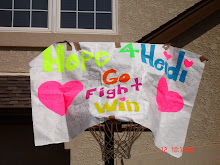
It's been a while since I posted, and to be fair, most of my recent posts were leveraging Steve's great writing. The Ironman for Heidi was such a great idea and a hit on so many levels. As of today 168 people signed up for the event on the Facebook Group, and i'm sure many more were following on the blog. The Hope for Heidi page is now showing $12,665.00 in donations, which is up $3000 from when Steve first conceived the idea, and since the site does not update donations automatically, there's probably more to be posted after this long holiday weekend.
As you probably know, with ALS, there is nothing we can do to prevent the dieing of neurons and the subsequent wasting of muscles, so the Ironman is a fitting "opposite" in terms of demonstrating the possibilities of human strength and endurance. This obviously does not end here and as long as Steve, or any other Ironman athlete wants to participate "4 Heidi", it will go on. Thanks again to Steve and Laura, and to everyone else that supported and contributed.
Peace out for now.
Bill
As you probably know, with ALS, there is nothing we can do to prevent the dieing of neurons and the subsequent wasting of muscles, so the Ironman is a fitting "opposite" in terms of demonstrating the possibilities of human strength and endurance. This obviously does not end here and as long as Steve, or any other Ironman athlete wants to participate "4 Heidi", it will go on. Thanks again to Steve and Laura, and to everyone else that supported and contributed.
Peace out for now.
Bill
Tuesday, September 1, 2009
Steve's account of the Ironman...
Below is Steve's amazing and awe inspiring account of his race. As you read, you will see that an Ironman is nothing to be taken lightly, people literally die competing in these things. Thank you again, Steve, you have lightened Heidi's heart and inspired all of us that know about this. I've never been much of a runner, or a biker or swimmer for that matter, but next year I'll make it if I can...maybe they will have a beach volleyball tournament to accompany the race next year. I hope you qualify for the Kona race in the 45's. It would be hard to keep me away from that!
======Begin Steve's 2 part message...=======
Ironman Canada Race Day -- August 30
The Ironman for Heidi project is one of those rare, great life experiences. And as an added bonus, it just happens that this experience has given me more than I have given it. Though I did donate 7834 burned calories to the effort yesterday.Let’s start the story of the Ironman with the day after the Ironman. Because today I learned just how lucky I was to finish.
I awoke and limped to the bathroom, where my legs objected to the squatting motion necessary to sit on the toilet. So I stood a couple feet further in front of the toilet than is usual and fell back, catching the toilet seat behind me, then executing a triceps press into the seated position. My stomach muscles screamed for mercy.
After a cup of coffee, I checked out my bike and realized that my rear tire had gone completely flat. This same tire held air all throughout the 112 mile bike-leg yesterday. I then flipped through the newpaper account of the race and learned that a man died during the swim. So, already, by any measure, I was fortunate yesterday. Here’s how it unfolded.
At 3 a.m. on race morning, I executed my normal pre-race routine -- 3 Boosts, a bottle of Gatorade and one very strong cup of coffee. The goal is to use the facilities before the race, because, while most Ironman competitors think nothing of peeing themselves during the race, we generally draw the line at solids.I got to the transition early and headed over to put on my wetsuit, pump up my tires and get body marked (this is where they write your race number on your arms with magic marker so that they can identify the body, quite literally). I asked the woman with the felt-tip to upgrade my “4 Heidi” tattoo while she was at it. She asked about Heidi and wished her well.
Before heading to the water for a warm-up swim, I stumbled into Jeri and Monica, two women who are on the same club team as me. I helped them put on their wetsuits and we started walking towards the beach. We walked past a line of competitors who were waiting to use the porta potties, so I asked my friends whether they needed to make a pit stop before we headed for the lake. Monica said: “I’m peeing right now”. I love this sport.
The swim start is perhaps the most impressive spectacle in Ironman racing. Because all 2600 athletes start at once, the starting line is perhaps 300 yards wide and 20 rows deep. Everyone futilely looks for that special starting spot where they can avoid the hand-to-hand fighting that is part of the Ironman swim start. But I have learned that there is no avoiding the contact of the swim start. So rather than wasting time trying to avoid it, I decided to confront it head-on. I seeded myself in the front row, in the middle, knowing that a few hundred faster swimmers would provide me an opportunity to swim faster in their substantial current. Unfortunately, those same swimmers would beat me to a pulp as they raced for the front of the pack.
“Maranatha”, the Ironman Canada cannon fired, and I immediately dove in and began swimming for my life. The contact was immediate and personal. I may have accidentally fathered a couple children in the first two hundred yards -- or I may now be gay. It’s hard to say. As always, the water became less congested after the turn-around at the 1.2 mile mark. I followed some big feet with a red timing chip strap most of the way back to shore and exited the water in 1 hour 8 minutes and some change.
I transitioned to the bike and was moving along briskly for the first 35 miles. Unfortunately, the fun ended there as I hit the first 1500 foot climb at Richter Pass, riding with about 15 guys and gals going roughly the same pace as me. Most of the group shot up the climb like they were riding the Tour de France. I rode conservatively at the back, in part because I had to pee and didn’t want to douse anyone, and in part because I was fearful of turning the marathon into a 26 mile walk.After cresting the pass, I put my nose on the front wheel and quickly had the speedometer pegged at 45 mph on the steep 5 mile downhill. One by one, I caught my hard working friends before the bottom and we reformed our group, minus a few timid souls who rode the brakes down the hill. I must have really nailed my hydration, because I had pee again (the second time is always easier. You’re not worried about being covered in urine, since you are already covered in urine).
It was at this point that we noticed trouble in the wind, literally. The wind was blowing at about 30 mph from the west directly at us, which in and of itself sucked, but we were really worried about the eye watering smoke that the wind was pushing into the valley. There are 200 forest fires raging near the Okanagan Valley and the wind had shifted -- in a bad way. We soldiered on, taking shallow breaths, as we rode over an endless series of rolling hills and finally, 20 miles from end of the bike, up the dreaded Yellow Lake Pass. Yellow Lake is a 7-mile, 1500 foot climb, the last really tough stretch before the descent back to Penticton.
Having ridden conservatively to this point, I felt remarkably strong going up Yellow Lake. And with the energy supplied by hundreds of spectators lining the road on the steepest part of the climb, the ascent was not entirely unbearable.After the climb, I still had plenty left in the tank and was riding at a good clip on the flats back into town, when I was caught by a guy named Doug.Being the only survivors from the original group of fifteen and with our bike-to-run transition just a couple miles away, Doug and I allowed ourselves a brief moment of human interaction. We rode side-by-side through town with fans lining both sides of Main Street, Penticton, soaking up the cheers of the crowd. We were smiling at each other, and Doug was saying that he was glad to be done with the bike-leg, when suddenly, a small child jumped from the crowd into the road directly into Doug’s path. There was no time to stop. I heard Doug shout, “Watch...!” The rest was cut off by the sickening sound of Doug’s bike smashing to the ground. By the time I slowed down and looked back, a number of people, including race officials who were guarding the intersection, were surrounding the crash and it was impossible to tell how badly he was injured. I considered going back, but it was clear that there was nothing for me to do. Another group of riders came up from behind and I made the difficult decision to get moving again.
=====Part 2=====
I rode into what we call T2 (the transition two -- the first being the swim to bike transition -- T1), with a 5 hour 22 minute bike split. I expected to go about 5:20, so in the world of day long races, I was right on time. I needed to run a 3:30 marathon to finish in 10:05 -- a stretch -- but a 3:45 marathon seemed achievable.With that thought in mind, I threw on my running shoes and began the marathon.
I hoped that my conservative bike ride would translate into a solid 8 minute per mile run pace. And it did -- for two miles. Then it settled into something in the 9:00 to 9:30 per mile range and no amount of effort would allow me to run faster. Even peeing didn’t help. It just soaked my socks, making them squishy and uncomfortable. On the other hand, I seemed to have good endurance and I was confident that I could make up ground on my competitors by being consistent, if not fast.
Sure enough, at mile 10 I began catching and passing a number of the gazelles who had sprinted out of T2. Some were walking, others were enjoying time in the porta potties and still others were bent over the guard-rail ridding themselves of GU’s, Gatorade and whatever else wasn’t digesting. I trotted along like this for mile after mile after mile. That is, until mile 22. Mile 22 for a marathon runner is a dark place. It is at this point in a marathon when many “hit the wall”. But in an Ironman, mile 22 of the marathon means nothing. It’s 136 miles into the race. Everything hurts and life has sucked for a very long time. In fact, mile 22 of the marathon is so close to the finish that some people get their second wind at this point. But at mile 22 of this marathon, I slammed into the supposedly non-existent wall so hard I almost broke my face.
It all started when the standard-Ironman-issue searing pain in my quads warned me of an impending cramp. So trying to stave off quad cramps, I changed my running style to shift the work to my hamstrings, which had the effect of causing pain in my left knee. To alleviate that pain, I adopted yet another running style, landing more on my forefoot. And that’s when a little known muscle tucked behind the achilles tendon cramped so hard it almost felled me. I gingerly walked a few steps and found that those achilles muscles didn’t mind walking -- they just hated running.
By this time, my original time goals were not achievable due to my slower than expected marathon, but there was no way I was going to miss out on finishing under 11 hours -- unless, of course, I couldn’t run. In which case it didn’t matter that I had over 50 minutes to travel a mere 4 miles. I couldn’t make.I took a deep breath and looked at my arms. “4 Heidi” was why I was here and I knew then that it didn’t matter when I finished, just that I needed to finish. I instantly felt calm and more relaxed than I had been all day. And as I continued to walk I could feel the cramps easing. After a minute or two, I tested out a jog. And then, almost like an out of body experience, the jogging began to feel like floating, literally like running on a cushion of air. From that point on, whenever I started to feel tense, I would look at my arm and that would calm my mind, and the mind would do what the body couldn’t.
I easily ran the next two miles in under 20 minutes and knew I would have no trouble finishing in under 11 hours. I was inspired and relaxed and nothing would stop me.About the time, I ran up behind one of my competitors who was walking. His name was Josh and he was clearly in bad shape. As I ran by, I said “come on, let’s finish this”. This is a pretty common thing to say, but generally the response is “I can’t run because of _______”.
Josh looked up and said “let’s do it”, and began running beside me. We spent the next couple miles chatting and encouraging each other, all the while working our way closer and closer to the finish line. As we broke the tape and were caught by a couple volunteers, we cemented our friendship with a sweaty hug and a picture.It was a great way to end the day. It ended just the way it started, inspired by friends, first the old, then the new.
For the record, I finished in 10 hours 54 minutes and 7 seconds. John Davis wins the Ipod with a prescient guess of 10:53:20. Brett Warta finished second, winning the Canada Speedo prize, which is fortunate, since he may be the only other person who fits into a size 28 banana hammock. Honorable mention goes to my old fraternity buddy Otto Koerner as well as Todd Renard and Barbara Kelly who all made guesses within about 4 minutes of my finishing time.And also for the record, in the never-say-die spirit of the Ironman, Doug not only remounted his broken bike and made it to T2, he strapped on his running shoes and finished the race.Thanks everyone.
After I start walking again, maybe we'll talk about Ironman for Heidi II. The one where someone from this group joins me and straps on a matching speedo for charity. :) And yes, Kay. The picture will be on the way shortly.
=======END====
THANKS AGAIN STEVE!
======Begin Steve's 2 part message...=======
Ironman Canada Race Day -- August 30
The Ironman for Heidi project is one of those rare, great life experiences. And as an added bonus, it just happens that this experience has given me more than I have given it. Though I did donate 7834 burned calories to the effort yesterday.Let’s start the story of the Ironman with the day after the Ironman. Because today I learned just how lucky I was to finish.
I awoke and limped to the bathroom, where my legs objected to the squatting motion necessary to sit on the toilet. So I stood a couple feet further in front of the toilet than is usual and fell back, catching the toilet seat behind me, then executing a triceps press into the seated position. My stomach muscles screamed for mercy.
After a cup of coffee, I checked out my bike and realized that my rear tire had gone completely flat. This same tire held air all throughout the 112 mile bike-leg yesterday. I then flipped through the newpaper account of the race and learned that a man died during the swim. So, already, by any measure, I was fortunate yesterday. Here’s how it unfolded.
At 3 a.m. on race morning, I executed my normal pre-race routine -- 3 Boosts, a bottle of Gatorade and one very strong cup of coffee. The goal is to use the facilities before the race, because, while most Ironman competitors think nothing of peeing themselves during the race, we generally draw the line at solids.I got to the transition early and headed over to put on my wetsuit, pump up my tires and get body marked (this is where they write your race number on your arms with magic marker so that they can identify the body, quite literally). I asked the woman with the felt-tip to upgrade my “4 Heidi” tattoo while she was at it. She asked about Heidi and wished her well.
Before heading to the water for a warm-up swim, I stumbled into Jeri and Monica, two women who are on the same club team as me. I helped them put on their wetsuits and we started walking towards the beach. We walked past a line of competitors who were waiting to use the porta potties, so I asked my friends whether they needed to make a pit stop before we headed for the lake. Monica said: “I’m peeing right now”. I love this sport.
The swim start is perhaps the most impressive spectacle in Ironman racing. Because all 2600 athletes start at once, the starting line is perhaps 300 yards wide and 20 rows deep. Everyone futilely looks for that special starting spot where they can avoid the hand-to-hand fighting that is part of the Ironman swim start. But I have learned that there is no avoiding the contact of the swim start. So rather than wasting time trying to avoid it, I decided to confront it head-on. I seeded myself in the front row, in the middle, knowing that a few hundred faster swimmers would provide me an opportunity to swim faster in their substantial current. Unfortunately, those same swimmers would beat me to a pulp as they raced for the front of the pack.
“Maranatha”, the Ironman Canada cannon fired, and I immediately dove in and began swimming for my life. The contact was immediate and personal. I may have accidentally fathered a couple children in the first two hundred yards -- or I may now be gay. It’s hard to say. As always, the water became less congested after the turn-around at the 1.2 mile mark. I followed some big feet with a red timing chip strap most of the way back to shore and exited the water in 1 hour 8 minutes and some change.
I transitioned to the bike and was moving along briskly for the first 35 miles. Unfortunately, the fun ended there as I hit the first 1500 foot climb at Richter Pass, riding with about 15 guys and gals going roughly the same pace as me. Most of the group shot up the climb like they were riding the Tour de France. I rode conservatively at the back, in part because I had to pee and didn’t want to douse anyone, and in part because I was fearful of turning the marathon into a 26 mile walk.After cresting the pass, I put my nose on the front wheel and quickly had the speedometer pegged at 45 mph on the steep 5 mile downhill. One by one, I caught my hard working friends before the bottom and we reformed our group, minus a few timid souls who rode the brakes down the hill. I must have really nailed my hydration, because I had pee again (the second time is always easier. You’re not worried about being covered in urine, since you are already covered in urine).
It was at this point that we noticed trouble in the wind, literally. The wind was blowing at about 30 mph from the west directly at us, which in and of itself sucked, but we were really worried about the eye watering smoke that the wind was pushing into the valley. There are 200 forest fires raging near the Okanagan Valley and the wind had shifted -- in a bad way. We soldiered on, taking shallow breaths, as we rode over an endless series of rolling hills and finally, 20 miles from end of the bike, up the dreaded Yellow Lake Pass. Yellow Lake is a 7-mile, 1500 foot climb, the last really tough stretch before the descent back to Penticton.
Having ridden conservatively to this point, I felt remarkably strong going up Yellow Lake. And with the energy supplied by hundreds of spectators lining the road on the steepest part of the climb, the ascent was not entirely unbearable.After the climb, I still had plenty left in the tank and was riding at a good clip on the flats back into town, when I was caught by a guy named Doug.Being the only survivors from the original group of fifteen and with our bike-to-run transition just a couple miles away, Doug and I allowed ourselves a brief moment of human interaction. We rode side-by-side through town with fans lining both sides of Main Street, Penticton, soaking up the cheers of the crowd. We were smiling at each other, and Doug was saying that he was glad to be done with the bike-leg, when suddenly, a small child jumped from the crowd into the road directly into Doug’s path. There was no time to stop. I heard Doug shout, “Watch...!” The rest was cut off by the sickening sound of Doug’s bike smashing to the ground. By the time I slowed down and looked back, a number of people, including race officials who were guarding the intersection, were surrounding the crash and it was impossible to tell how badly he was injured. I considered going back, but it was clear that there was nothing for me to do. Another group of riders came up from behind and I made the difficult decision to get moving again.
=====Part 2=====
I rode into what we call T2 (the transition two -- the first being the swim to bike transition -- T1), with a 5 hour 22 minute bike split. I expected to go about 5:20, so in the world of day long races, I was right on time. I needed to run a 3:30 marathon to finish in 10:05 -- a stretch -- but a 3:45 marathon seemed achievable.With that thought in mind, I threw on my running shoes and began the marathon.
I hoped that my conservative bike ride would translate into a solid 8 minute per mile run pace. And it did -- for two miles. Then it settled into something in the 9:00 to 9:30 per mile range and no amount of effort would allow me to run faster. Even peeing didn’t help. It just soaked my socks, making them squishy and uncomfortable. On the other hand, I seemed to have good endurance and I was confident that I could make up ground on my competitors by being consistent, if not fast.
Sure enough, at mile 10 I began catching and passing a number of the gazelles who had sprinted out of T2. Some were walking, others were enjoying time in the porta potties and still others were bent over the guard-rail ridding themselves of GU’s, Gatorade and whatever else wasn’t digesting. I trotted along like this for mile after mile after mile. That is, until mile 22. Mile 22 for a marathon runner is a dark place. It is at this point in a marathon when many “hit the wall”. But in an Ironman, mile 22 of the marathon means nothing. It’s 136 miles into the race. Everything hurts and life has sucked for a very long time. In fact, mile 22 of the marathon is so close to the finish that some people get their second wind at this point. But at mile 22 of this marathon, I slammed into the supposedly non-existent wall so hard I almost broke my face.
It all started when the standard-Ironman-issue searing pain in my quads warned me of an impending cramp. So trying to stave off quad cramps, I changed my running style to shift the work to my hamstrings, which had the effect of causing pain in my left knee. To alleviate that pain, I adopted yet another running style, landing more on my forefoot. And that’s when a little known muscle tucked behind the achilles tendon cramped so hard it almost felled me. I gingerly walked a few steps and found that those achilles muscles didn’t mind walking -- they just hated running.
By this time, my original time goals were not achievable due to my slower than expected marathon, but there was no way I was going to miss out on finishing under 11 hours -- unless, of course, I couldn’t run. In which case it didn’t matter that I had over 50 minutes to travel a mere 4 miles. I couldn’t make.I took a deep breath and looked at my arms. “4 Heidi” was why I was here and I knew then that it didn’t matter when I finished, just that I needed to finish. I instantly felt calm and more relaxed than I had been all day. And as I continued to walk I could feel the cramps easing. After a minute or two, I tested out a jog. And then, almost like an out of body experience, the jogging began to feel like floating, literally like running on a cushion of air. From that point on, whenever I started to feel tense, I would look at my arm and that would calm my mind, and the mind would do what the body couldn’t.
I easily ran the next two miles in under 20 minutes and knew I would have no trouble finishing in under 11 hours. I was inspired and relaxed and nothing would stop me.About the time, I ran up behind one of my competitors who was walking. His name was Josh and he was clearly in bad shape. As I ran by, I said “come on, let’s finish this”. This is a pretty common thing to say, but generally the response is “I can’t run because of _______”.
Josh looked up and said “let’s do it”, and began running beside me. We spent the next couple miles chatting and encouraging each other, all the while working our way closer and closer to the finish line. As we broke the tape and were caught by a couple volunteers, we cemented our friendship with a sweaty hug and a picture.It was a great way to end the day. It ended just the way it started, inspired by friends, first the old, then the new.
For the record, I finished in 10 hours 54 minutes and 7 seconds. John Davis wins the Ipod with a prescient guess of 10:53:20. Brett Warta finished second, winning the Canada Speedo prize, which is fortunate, since he may be the only other person who fits into a size 28 banana hammock. Honorable mention goes to my old fraternity buddy Otto Koerner as well as Todd Renard and Barbara Kelly who all made guesses within about 4 minutes of my finishing time.And also for the record, in the never-say-die spirit of the Ironman, Doug not only remounted his broken bike and made it to T2, he strapped on his running shoes and finished the race.Thanks everyone.
After I start walking again, maybe we'll talk about Ironman for Heidi II. The one where someone from this group joins me and straps on a matching speedo for charity. :) And yes, Kay. The picture will be on the way shortly.
=======END====
THANKS AGAIN STEVE!
Friday, August 28, 2009
Update from Steve and a little more
I'm sitting down with my "Tim Hortons - Always Fresh" cup, which I my buddy Big B Gatzke schmoozed out of the Timmy's store on Vancouver Island about 10 years ago on a salmon/steelhead float trip. Figured it was a fitting java holder for my read of Steve's post this am. Sounds like he's got a bit of the pre-race jitters, which I certainly would have if I were swimming 2.4 miles, Biking a hundred and twleve and then tacking on a full marathon. In fact, I think I would be feeling faint, but then again, I have not trained like Steve has, so that would be expected. He's going to do great and show him some support on the FB page with encouraging messages like "Go get 'em Steve" or "I'll guarantee you a spot in the final of the US Open next year if you hit my time." or "If Earl Boykins can play in the NBA, so can you." Of course neither of the last two make any sense if you don't know that early in his sports career Steve excelled at both Tennis and Basketball, and probably would love to be a pro of either, at least a little more than grinding out a gruelling course in the hills of Canada's wine country, but alas he's just a finely tuned grinding machine these days. Of course, if you don't know that Earl Boykins is about 5'6, then you don't get that joke either, but that's OK.
Here's Steve's post from this am...GO GET 'EM buddy!
=====Begin Steve's post======
Penticton, Canada -- Wednesday, August 26, 2009 -- Wow, we’re here.
“Spectacular” is a fine word to describe the drive from Bridal Veil east to Penticton -- one-hundred miles of mountain peaks and rivers . I used up a camera battery shooting blurry pictures through a dirty window while Laura slung the FJ around a million hair-pin turns.
By the way, Canadians don’t have $1.09 per gallon gas or 100 mph speed limits. It just seems that way to people who use the English system of weights and measures. After 2 days in Canada, I realized this when I filled the FJ with 53 gallons of gas. It only held 20 gallons in the U.S.
After stopping at a road-side fruit stand about 30 miles outside Penticton, our route merged with the last 25 miles of the Ironman Canada bike course. I watched as the elevation went from 1,000 feet to 2,500 feet in about 7 miles. At first, when I told Laura we were on the Ironman bike course, she said, “no way, this is too steep. They don’t make you climb mountains in an Ironman.”
I agreed, hopeful that she was right as usual. But even the infallible are sometimes un-right (which is different than “wrong”, a word that I don’t use when speaking of opinions offered by my superiors).
So, if you’re tracking me online and you see my average speed drop from 20+ mph over the first 90 miles, to a speed that makes it appear that I have dismounted the bike and am carrying it up the mountain -- you will know that I have arrived at Yellow Lake Pass.
Penticton, Canada -- Thursday, August 27, 2009
This morning around 8 a.m., I went for a 30 minute swim on the Ironman course. The water is clear, the bottom is soft sand and the water temperature is 70 degrees. If I weren’t visualizing myself being consumed by the violent maelstrom that is the beginning of the Ironman mass swim start, this might have been one of the most peaceful open-water swims I’d ever done. Unfortunately, all I’m thinking about this morning is a strategy for surviving the first 1000 yards of the swim without swallowing gallons of water and a fellow competitor’s fist.
So much physical and organizational effort has gone into preparing for this one day that a person can’t help but to consider all that might go wrong. In Laura’s first Half-Ironman earlier this year, she was kicked in the right eye in the first seconds of the race and had to swim 1.2 miles with the right side of her goggles flooded. In Ironman races, people commonly suffer heat stroke, dehydration, over-hydration, hypothermia, blisters, sunburn and any number of gastric maladies. So preparation is critical. Unfortunately, I’m more known for overcoming my preparational shortcomings than for getting the preparation right in the first place.
This afternoon, Laura introduced me to Philip, a fellow Ironman competitor who is staying at the same B&B as us. Philip is from Frankfurt, Germany, which I’m taking as a sign that someone is sending us army brats a message.
Because Philip and I were both a little nervous about the extent of the climbing we’d be doing on the bike-leg of the race, we threw our bikes on the FJ and drove to the foot of the first long, steep climb at mile 40 -- Richter Pass. The climb was 7 miles long and it took us 30 minutes to climb.
Naturally, the ascent seemed easier than it will during the race. For one, we started at the bottom of the climb, not 40 miles north at the swim-to-bike transition. Neither had we completed a 2.4 mile swim. Nevertheless, we were happy that it wasn’t one of those hills where you’re forced to stand on the pedals and tear your bike to pieces, inching you way to the top.
Tomorrow morning is the underpants run. Pictures to follow, Speedo fans.
============End Steve's post=================
I should be done on that nice light note, but I am re-posting another comment on my string about Mindy Goodin. This type of post is something that I think is important for all who read the blog to see, and if I don't re-post, most who read this blog won't see them. Fortunately, I am notified whenever there is a comment on one of my posts. Here it is:
=====Begin post from Anonymous poster=======
Anonymous has left a new comment on your post "OK, this one a long time coming...Mindy...Why?":
Bill, my wife went to see Mindy a few years ago for a chronic fatigue/ achiness/ muscle weakness/ neurologic symptoms. She had already seen neuromuscular specialists in Denver who thought she had a viral illness causing her symptoms. Let me preface this further with saying that I'm an internal medicine doctor. She told my wife to take a whole bunch of different antibiotics for lyme, parasites, and who knows what. I didn't agree with it, but my wife went ahead and took them. No help at all. I talked to some specialists in infectious diseases who said it's all a scam and that nobody who really looks at the case thinks Dr. Martz actually had ALS.
The problem is that scam artists like them take advantage of people who have these vague illnesses (in some cases like fibromyalgia, chronic fatigue, etc, which have symptoms which are vague and can be related to any number of things) or established illnesses like ALS where there is no cure, and essentially think it's all the one think they want it to be (and that gets them money). The way she diagnosed illnesses and the treatments she gave are completely random, unfounded, and definitely not based on ANY research (I looked!) If I practiced that way, I'd be guilty of malpractice. I completely understand hoping for a cure, as I had a friend die of ALS at 35.
To anyone reading, I'd also say to put your efforts into finding respectable researchers at good institutions. Fortunately my wife stopped seeing Mindy (but not until we shelled out a lot of $) and fortunately we haven't heard from her since.
=====================End Post=================
My comment: Thank you very much for this post. It is another sad story related to Mindy, and the more I read things like this, the more angry I get about this. I don't have time or space in my heart for any anger right now, at least not any more that tries to creep in on me every day, so I have to let this pass, for now.
Peace,
B.
Here's Steve's post from this am...GO GET 'EM buddy!
=====Begin Steve's post======
Penticton, Canada -- Wednesday, August 26, 2009 -- Wow, we’re here.
“Spectacular” is a fine word to describe the drive from Bridal Veil east to Penticton -- one-hundred miles of mountain peaks and rivers . I used up a camera battery shooting blurry pictures through a dirty window while Laura slung the FJ around a million hair-pin turns.
By the way, Canadians don’t have $1.09 per gallon gas or 100 mph speed limits. It just seems that way to people who use the English system of weights and measures. After 2 days in Canada, I realized this when I filled the FJ with 53 gallons of gas. It only held 20 gallons in the U.S.
After stopping at a road-side fruit stand about 30 miles outside Penticton, our route merged with the last 25 miles of the Ironman Canada bike course. I watched as the elevation went from 1,000 feet to 2,500 feet in about 7 miles. At first, when I told Laura we were on the Ironman bike course, she said, “no way, this is too steep. They don’t make you climb mountains in an Ironman.”
I agreed, hopeful that she was right as usual. But even the infallible are sometimes un-right (which is different than “wrong”, a word that I don’t use when speaking of opinions offered by my superiors).
So, if you’re tracking me online and you see my average speed drop from 20+ mph over the first 90 miles, to a speed that makes it appear that I have dismounted the bike and am carrying it up the mountain -- you will know that I have arrived at Yellow Lake Pass.
Penticton, Canada -- Thursday, August 27, 2009
This morning around 8 a.m., I went for a 30 minute swim on the Ironman course. The water is clear, the bottom is soft sand and the water temperature is 70 degrees. If I weren’t visualizing myself being consumed by the violent maelstrom that is the beginning of the Ironman mass swim start, this might have been one of the most peaceful open-water swims I’d ever done. Unfortunately, all I’m thinking about this morning is a strategy for surviving the first 1000 yards of the swim without swallowing gallons of water and a fellow competitor’s fist.
So much physical and organizational effort has gone into preparing for this one day that a person can’t help but to consider all that might go wrong. In Laura’s first Half-Ironman earlier this year, she was kicked in the right eye in the first seconds of the race and had to swim 1.2 miles with the right side of her goggles flooded. In Ironman races, people commonly suffer heat stroke, dehydration, over-hydration, hypothermia, blisters, sunburn and any number of gastric maladies. So preparation is critical. Unfortunately, I’m more known for overcoming my preparational shortcomings than for getting the preparation right in the first place.
This afternoon, Laura introduced me to Philip, a fellow Ironman competitor who is staying at the same B&B as us. Philip is from Frankfurt, Germany, which I’m taking as a sign that someone is sending us army brats a message.
Because Philip and I were both a little nervous about the extent of the climbing we’d be doing on the bike-leg of the race, we threw our bikes on the FJ and drove to the foot of the first long, steep climb at mile 40 -- Richter Pass. The climb was 7 miles long and it took us 30 minutes to climb.
Naturally, the ascent seemed easier than it will during the race. For one, we started at the bottom of the climb, not 40 miles north at the swim-to-bike transition. Neither had we completed a 2.4 mile swim. Nevertheless, we were happy that it wasn’t one of those hills where you’re forced to stand on the pedals and tear your bike to pieces, inching you way to the top.
Tomorrow morning is the underpants run. Pictures to follow, Speedo fans.
============End Steve's post=================
I should be done on that nice light note, but I am re-posting another comment on my string about Mindy Goodin. This type of post is something that I think is important for all who read the blog to see, and if I don't re-post, most who read this blog won't see them. Fortunately, I am notified whenever there is a comment on one of my posts. Here it is:
=====Begin post from Anonymous poster=======
Anonymous has left a new comment on your post "OK, this one a long time coming...Mindy...Why?":
Bill, my wife went to see Mindy a few years ago for a chronic fatigue/ achiness/ muscle weakness/ neurologic symptoms. She had already seen neuromuscular specialists in Denver who thought she had a viral illness causing her symptoms. Let me preface this further with saying that I'm an internal medicine doctor. She told my wife to take a whole bunch of different antibiotics for lyme, parasites, and who knows what. I didn't agree with it, but my wife went ahead and took them. No help at all. I talked to some specialists in infectious diseases who said it's all a scam and that nobody who really looks at the case thinks Dr. Martz actually had ALS.
The problem is that scam artists like them take advantage of people who have these vague illnesses (in some cases like fibromyalgia, chronic fatigue, etc, which have symptoms which are vague and can be related to any number of things) or established illnesses like ALS where there is no cure, and essentially think it's all the one think they want it to be (and that gets them money). The way she diagnosed illnesses and the treatments she gave are completely random, unfounded, and definitely not based on ANY research (I looked!) If I practiced that way, I'd be guilty of malpractice. I completely understand hoping for a cure, as I had a friend die of ALS at 35.
To anyone reading, I'd also say to put your efforts into finding respectable researchers at good institutions. Fortunately my wife stopped seeing Mindy (but not until we shelled out a lot of $) and fortunately we haven't heard from her since.
=====================End Post=================
My comment: Thank you very much for this post. It is another sad story related to Mindy, and the more I read things like this, the more angry I get about this. I don't have time or space in my heart for any anger right now, at least not any more that tries to creep in on me every day, so I have to let this pass, for now.
Peace,
B.
Wednesday, August 26, 2009
Steve's second post from the road
Hi All,
Attached is Steve's second post from the road. He's already done a third, so I'll post that one later. I am enjoying Steve's writing and love his humor. Some of the photos on the FB group page (Ironman for Heidi) are really funny, so if you have access, you should check them out. As a side note, i am not sure how much money has been contributed to cause as a result of Steve's great idea, but the Hope for Heidi page has just recently cleared over $11,000 raised in our quest to reach $50,000.00 for ALS-TDI.
On the home front, we are still battling. I received a different, manual wheelchair for Heidi yesterday from the local ALS Association's closet, and hopefully today we can test it out and it will work for her. Times are tough, but all your support encourages us all. Thanks again.
Bill
====Begin Steve's 2nd Post =====
Port Angeles, WA 3:30 p.m. -- August 23, 2009
Laura had to drive the whole way from Eugene to Port Angeles. It was my job to make ferry reservations and that didn’t happen. Without a reservation, we absolutely had to get to the ferry by 3:30. No 3:30, no boat. No boat, no Canada -- and were ready to meet some Canadians, dammit!
We made it at exactly 3:30. That gave us a couple hours to enjoy Port Angeles, which, for a town built with a fisherman’s wharf feel, has a strange affinity for metal statues. Naturally, I felt compelled to see if the the statues looked good in a Speedo, to Laura’s chagrin. Check out my IM for Heidi pictures for the best shots.
The boat crossing to Victoria, across the Straits of Juan De Fuca, was rough. The ferry held at least a hundred cars and RVs in it’s hold and still that sucker rolled a ton. Laura was looking a little green for a while, but I distracted her by discussing my strategy for swimming to shore if the boat were to sink. Landing in Victoria, we had a little trouble with the border patrol -- not that we were dealing with Sherlock Holmes. First, we said that there was no fresh fruit in the car. Fortunately, Canadians appear to have never seen bananas; otherwise they would have noticed an entire 5 banana bushel sitting in plain view on the center console.
Then they asked for not only our passports, but our driver’s licenses. I had stupidly forgotten my driver’s license in the last pair of pants I wore in California, but I figured I could muddle through the trip with just my passport. It seems that you are not permitted to enter Canada if you’ve had a DUI, and I had just become a prime suspect. The officer apparently wasn’t buying that I was in Canada to do Ironman Canada despite the triathlon bikes hanging off the back of the FJ. In his mind, I was a drunk driver trying to sneak into the country. Fortunately, for the first time ever, the U.S. DMV came through for me, confirming that I was just an idiot and not someone with a suspended license trying to sneak into Canada.
By the way, Victoria is beautiful!
===========End Steve's second post===================
Attached is Steve's second post from the road. He's already done a third, so I'll post that one later. I am enjoying Steve's writing and love his humor. Some of the photos on the FB group page (Ironman for Heidi) are really funny, so if you have access, you should check them out. As a side note, i am not sure how much money has been contributed to cause as a result of Steve's great idea, but the Hope for Heidi page has just recently cleared over $11,000 raised in our quest to reach $50,000.00 for ALS-TDI.
On the home front, we are still battling. I received a different, manual wheelchair for Heidi yesterday from the local ALS Association's closet, and hopefully today we can test it out and it will work for her. Times are tough, but all your support encourages us all. Thanks again.
Bill
====Begin Steve's 2nd Post =====
Port Angeles, WA 3:30 p.m. -- August 23, 2009
Laura had to drive the whole way from Eugene to Port Angeles. It was my job to make ferry reservations and that didn’t happen. Without a reservation, we absolutely had to get to the ferry by 3:30. No 3:30, no boat. No boat, no Canada -- and were ready to meet some Canadians, dammit!
We made it at exactly 3:30. That gave us a couple hours to enjoy Port Angeles, which, for a town built with a fisherman’s wharf feel, has a strange affinity for metal statues. Naturally, I felt compelled to see if the the statues looked good in a Speedo, to Laura’s chagrin. Check out my IM for Heidi pictures for the best shots.
The boat crossing to Victoria, across the Straits of Juan De Fuca, was rough. The ferry held at least a hundred cars and RVs in it’s hold and still that sucker rolled a ton. Laura was looking a little green for a while, but I distracted her by discussing my strategy for swimming to shore if the boat were to sink. Landing in Victoria, we had a little trouble with the border patrol -- not that we were dealing with Sherlock Holmes. First, we said that there was no fresh fruit in the car. Fortunately, Canadians appear to have never seen bananas; otherwise they would have noticed an entire 5 banana bushel sitting in plain view on the center console.
Then they asked for not only our passports, but our driver’s licenses. I had stupidly forgotten my driver’s license in the last pair of pants I wore in California, but I figured I could muddle through the trip with just my passport. It seems that you are not permitted to enter Canada if you’ve had a DUI, and I had just become a prime suspect. The officer apparently wasn’t buying that I was in Canada to do Ironman Canada despite the triathlon bikes hanging off the back of the FJ. In his mind, I was a drunk driver trying to sneak into the country. Fortunately, for the first time ever, the U.S. DMV came through for me, confirming that I was just an idiot and not someone with a suspended license trying to sneak into Canada.
By the way, Victoria is beautiful!
===========End Steve's second post===================
Subscribe to:
Posts (Atom)